

Health Library
Chronic inflammatory demyelinating polyneuropathy
Chronic inflammatory demyelinating polyradiculoneuropathy; Polyneuropathy - chronic inflammatory; CIDP; Chronic inflammatory polyneuropathy; Guillain-Barré - CIDP
Chronic inflammatory demyelinating polyneuropathy (CIDP) is a disorder that involves nerve swelling and irritation (inflammation) that leads to a loss of strength or sensation.
Images
I Would Like to Learn About:
Causes
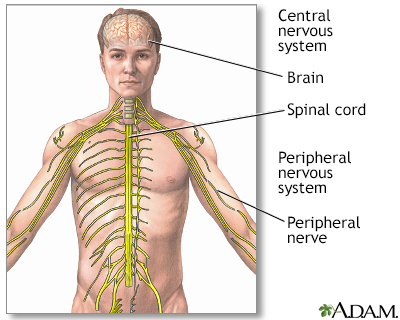
CIDP is one cause of damage to nerves outside the brain or spinal cord (peripheral neuropathy). Polyneuropathy means several nerves are involved. CIDP often affects both sides of the body.
CIDP is caused by an abnormal immune response. CIDP occurs when the immune system attacks the myelin cover of the nerves. For this reason, CIDP is thought to be an autoimmune disease.
Health care providers also consider CIDP as the chronic form of Guillain-Barré syndrome.
The specific triggers of CIDP vary. In many cases, the cause cannot be identified.
CIDP may cause similar problems as neuropathy occurring in other conditions, such as:
- Chronic hepatitis
- Diabetes
- HIV/AIDS
- Immune system disorders due to cancer
- Inflammatory bowel disease
- Systemic lupus erythematosus
- Cancer of the lymph system
- Overactive thyroid
Symptoms
Symptoms include any of the following:
- Problems walking due to weakness or lack of feeling in the feet
- Trouble using the arms and hands or legs and feet due to weakness
- Sensation changes, such as numbness or decreased sensation, pain, burning, tingling, or other abnormal sensations (usually affects the feet first, then the arms and hands)
Other symptoms that can occur with CIDP include:
- Abnormal or uncoordinated movement
- Problems breathing
- Fatigue
- Hoarseness, changing voice or slurred speech
Exams and Tests
Your provider will perform a physical exam and ask about the symptoms, focusing on the nervous system and muscles.
Tests that may be ordered include:
- Electromyography (EMG) to check the muscles and the nerves that control the muscles
- Nerve conduction tests to check how fast electrical signals move through a nerve
- Nerve biopsy to remove a small piece of a nerve for examination
- Spinal tap (lumbar puncture) to check the fluid that surrounds the brain and spinal cord
- Blood tests may be done to look for specific proteins that are causing the immune attack on the nerves
- Lung function tests to check if breathing is affected
Depending on the suspected cause of CIDP, other tests, such as x-rays, imaging scans, and blood tests, may be done.
Treatment
The goal of treatment is to reverse the attack on the nerves. In some cases, nerves can heal and their function can be restored. In other cases, nerves are badly damaged and cannot heal, so treatment is aimed at preventing the disease from getting worse.
Which treatment is given depends on how severe the symptoms are, among other things. The most aggressive treatment is only given if you have difficulty walking, breathing, or if symptoms don't allow you to care for yourself or work.
Treatments may include:
- Corticosteroids to help reduce inflammation and relieve symptoms
- Other medicines that suppress the immune system (for some severe cases)
- Plasmapheresis or plasma exchange to remove antibodies from the blood
- Intravenous immune globulin (IVIg), which involves injecting antibodies into the bloodstream to reduce the effect of the antibodies that are causing the problem
- Efgartigimod, a biological agent that reduces inflammation that damages nerves
Outlook (Prognosis)
The outcome varies. The disorder may continue long term, or you may have repeated episodes of symptoms. Complete recovery is possible, but permanent loss of nerve function is not uncommon.
Possible Complications
Complications of CIDP include:
- Pain
- Permanent decrease or loss of sensation in areas of the body
- Permanent weakness or paralysis in areas of the body
- Repeated or unnoticed injury to an area of the body
- Side effects of medicines used to treat the disorder
When to Contact a Medical Professional
Contact your provider if you have a loss of movement or sensation in any area of the body, especially if your symptoms get worse.
Related Information
Muscle function lossPeripheral neuropathy
Acute
Guillain-Barre syndrome
Immune response
References
Barnes M, Craig A, Hearn SL. Peripheral nerve disorders. In: Cifu DX, Bowles AO, Eapen BC, et al, eds. Braddom's Physical Medicine and Rehabilitation. 7th ed. Philadelphia, PA: Elsevier; 2026:chap 42.
Katirji B. Disorders of peripheral nerves. In: Jankovic J, Mazziotta JC, Pomeroy SL, Newman NJ, eds. Bradley and Daroff's Neurology in Clinical Practice. 8th ed. Philadelphia, PA: Elsevier; 2022:chap 106.
National Institute of Neurological Disorders and Stroke website. Peripheral neuropathy. www.ninds.nih.gov/health-information/disorders/peripheral-neuropathy. Updated March 13, 2026. Accessed June 3, 2026.
Smith AG, Shy ME. Peripheral neuropathies. In: Goldman L, Cooney KA, eds. Goldman-Cecil Medicine. 27th ed. Philadelphia, PA: Elsevier; 2024:chap 388.
BACK TO TOPReview Date: 5/4/2026
Reviewed By: Joseph V. Campellone, MD, Professor of Neurology, Cooper-Inspira Neuroscience, Cooper Medical School of Rowan University, Camden, NJ. Review provided by VeriMed Healthcare Network. Also reviewed by David C. Dugdale, MD, Medical Director, Brenda Conaway, Editorial Director, and the A.D.A.M. Editorial team.
 | A.D.A.M., Inc. is accredited by URAC, for Health Content Provider (www.urac.org). URAC's accreditation program is an independent audit to verify that A.D.A.M. follows rigorous standards of quality and accountability. A.D.A.M. is among the first to achieve this important distinction for online health information and services. Learn more about A.D.A.M.'s editorial policy, editorial process and privacy policy. A.D.A.M. is also a founding member of Hi-Ethics. This site complies with the HONcode standard for trustworthy health information: verify here. |
The information provided herein should not be used during any medical emergency or for the diagnosis or treatment of any medical condition. A licensed medical professional should be consulted for diagnosis and treatment of any and all medical conditions. Links to other sites are provided for information only -- they do not constitute endorsements of those other sites. No warranty of any kind, either expressed or implied, is made as to the accuracy, reliability, timeliness, or correctness of any translations made by a third-party service of the information provided herein into any other language.
© 1997-
2026 A.D.A.M., a business unit of Ebix, Inc. Any duplication or distribution of the information contained herein is strictly prohibited.
All content on this site including text, images, graphics, audio, video, data, metadata, and compilations is protected by copyright and other intellectual property laws. You may view the content for personal, noncommercial use. Any other use requires prior written consent from Ebix. You may not copy, reproduce, distribute, transmit, display, publish, reverse-engineer, adapt, modify, store beyond ordinary browser caching, index, mine, scrape, or create derivative works from this content. You may not use automated tools to access or extract content, including to create embeddings, vectors, datasets, or indexes for retrieval systems. Use of any content for training, fine-tuning, calibrating, testing, evaluating, or improving AI systems of any kind is prohibited without express written consent. This includes large language models, machine learning models, neural networks, generative systems, retrieval-augmented systems, and any software that ingests content to produce outputs. Any unauthorized use of the content including AI-related use is a violation of our rights and may result in legal action, damages, and statutory penalties to the fullest extent permitted by law. Ebix reserves the right to enforce its rights through legal, technological, and contractual measures.
